

- Excerpt
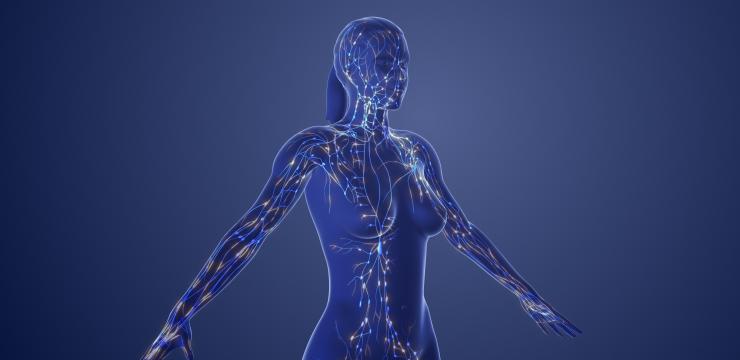
What is often forgotten in dealing with vascular health is that the lymphatic system forms an integral part of the entire vascular system and that endothelial cells form the inner lining of both the circulatory and the lymphatic vessels. The circulatory system is a closed system whose capillaries form the thinnest part. They consists of nothing but endothelial cells. This "endothelium" regulates the exchange of solids, gases and fluids between the blood and the surrounding tissues. The lymphatic system is an open system that is embedded in the surrounding tissues via loosely organized endothelial cells that are “anchored” within the extracellular matrix of its environment by strands of fibers. Since Masquelier's OPCs have a beneficial effect on all endothelial structures, they are highly relevant when it comes to improving and maintaining circulatory and lymphatic health.
Table of contents
The lymphatic system's purpose
Lymph is a faintly yellow fluid consisting of 95 percent water (lymph plasma) in which we find lymphocytes and other so called plasma proteins that exist only in the lymph. Lymph forms a key part in our defense and immune system. It originates from the flowing of fluid from the blood through the capillaries into the tissues, or into the intercellular spaces, where the fluid part of the blood, the blood’s plasma, is being “sucked up” by the lymph vessels. Eventually, the plasma is returned to the blood via the lymph nodes. In addition to draining off excess tissue fluid and returning it to the blood, the lymphatic endothelium transports waste products as well as dead blood cells, pathogenic organisms in case of infection, and malignant cells from cancerous growths. In the lymph nodes, invading bacteria are filtered and destroyed by the lymphocytes.
'Venolymphatic' unity
The lymphatic and circulatory systems cooperate in a dynamic and highly complex interplay aimed at maintaining the function and structure of all the organs of the body. Including the extracellular matrix in the tissues (the interstitial space), this system can be described as a 'venolymphatic' unity. This system is made of collagen, elastin and proteoglycans. Collagen provides its structure and elastin its flexibility. Proteoglycans are complexes of protein and large sugar molecules involving for instance glucosamine and chondroitin. Proteoglycans form part of the extracellular matrix, which facilitates the diffusion of fluids through the tissues. A change in one "vascular" factor results in far reaching consequences. A reduced vein tone triggers a slowdown of circulation with a simultaneous increase in pressure on the capillary level. There, the capillary membrane may succumb and become weak and more permeable. The surrounding tissue is saturated with excessive fluid and the tiny lymphatic capillaries are overburdened. This inundation results in local edema, also called lymphedema.
System failure
A failure of lymphatic drainage, in turn, causes fibrosis, a pathogenic growth of connective tissue, which may eventually result in thrombosis. This shows the importance of dissolving a venous-lymphatic congestion as early as possible. Even if it originates at the capillary level, it quickly affects the entire circulatory environment and should therefore be eradicated at the root. The effects of a distorted venolymphatic system are not always life threatening, but they genuinely bother millions and millions of people. When left unattended, venolymphatic disturbances such as lymphodema and high blood pressure may eventually upset the heart muscle, resulting in angina pectoris, cardiac arrest, or heart failure.
Testing Masquelier's OPCs' effect on lymph flow
To find out whether Masquelier's OPCs could enhance the flow of lymph medical specialist A. Pecking and colleagues of the Centre Huguenin in the Paris suburb of Saint-Cloud injected the harmless radioactive “tracer” named Technetium-99m (99mTc ) into the subcutaneous space between the first toes of the feet of 40 healthy males who voluntarily participated in a study aimed at measuring the effect of Masquelier’s OPCs on lymphatic motion. [I] The tracer, which emits gamma-rays that can be “seen” by an “x-ray” camera, is attached to a carrier. In this setting, the movement, dispersal and disappearance the 99mTc in the lymphatic system can be followed and measured. The disappearance of the carrier-tracer is caused by the actvity of macrophages ("waste-eaters") in the extracelluler matrix, the capacity of the macrophages to penetrate into the lymph vessels and, finally, the time it takes for the lymphatic system to discharge itself of the tracer.
Measuring the effects
The activity of Masquelier's OPCs was measured by: 1) following the disappearance of the radioactivity at the point of the injection for a period of 20 minute, which gives an indication of the “clearing” of the carrier by the extracellular matrix and the lymphatic system; 2) registration of the radioactivity at the point of the internal “small hammer” (malleolus) in the ankle and at the level of the knee, which gives an indication of the speed with which the lymph moves through the system.
Study design
The study was a placebo controlled double-blind cross-over study, which means that half of the participants first took 300 mg OPCs per day and then, after the cross-over, the placebo, while the other half first took the placebo and then the OPCs. OPCs and placebo were taken for 1 week and in between the OPCs and placebo, there was a “wash-out” period of 2 weeks. In both groups, the differences between placebo and OPCs were significant. Tests were performed on days 0 and 8 (first week), 21 (ending of the “wash-out”and beginning of the 4th week) and 28 (ending of the 4th week). On days 8 and 28, the researchers observed that OPCs induced a significant improvement in the disappearing of the radioactivity and “clearing” at the location of the injection, as well as an improvement of the lymph’s velocity in the foot and lower leg.
The significant effects
On average, the lymphatic speed, went up from 10.6 to 13.3 centimeters per minute in the 1st group and from 11.0 to 13.5 centimeters per minute in the 2nd group. Half life (disappearance) of the radioactivity went down from 81.8 minutes to 70.6 in the 1st group and from 83.2 to 68.7 in the 2nd. The “clearance” went up from 43.1 to 53.8 milliliters per minute in the 1st and from 41.3 to 55.8 milliliters per minute in the 2nd group. The placebo also influenced the response of the lymphatic system, but only to a minor degree. In their publication, the French researchers concluded that OPCs “are statistically more effective to stimulate the lymphatic system in healthy people than a placebo.”
Masquelier's OPCs at all times
The healthy interplay among all parts of the venolymphatic system is compromised by stress of a nutritional nature, by stress of a physical nature, and of course by a combination of both. Stress must be understood in terms of "too much" and "too little". Stress can be caused by the overwhelming presence of something as well as by the overwhelming absence of something. Nutritional stress, for instance, consists of more than overloading the venolymphatic system in a way that obstructs and immobilizes it. Deficiencies in essential nutrients are just as much part of nutritional stress because they can lead to malfunction, decay, and degeneration. A lack of vitamin C and OPCs combined with a lack of antioxidants puts great stress on the venolymphatic system. Likewise, physical stress is caused by 'overstraining' the system as well as by a lack of movement and exercise. Whatever the case may be, Masquelier's OPCs assist the venolymphatic system in health and disease at all times.
+ + + + + + + + +
[i] Oligomères procyanidoliques (Endotelon®) et système lymphatique. A. Pecking, B. Picandet, K. Hacene, F. Lokiec, P. Guerin; ARTERES ET VEINES, Vol. 6, No 6, 1987.


